
Blog
Oral Cavity as a Hidden Niche for H. pylori

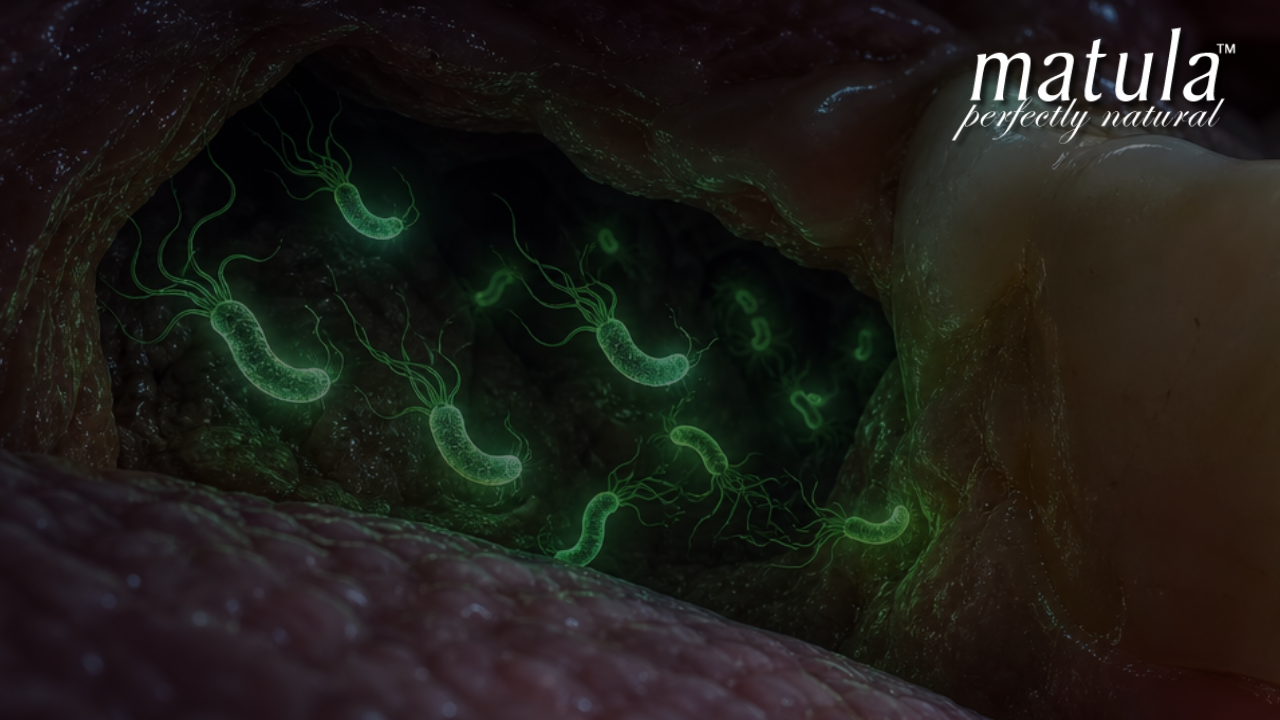
Helicobacter pylori has long been regarded as a strictly gastric pathogen. Recent research complicates that picture: dental plaque, periodontal pockets, and even caries lesions have all yielded detections of the bacterium, pointing to the mouth as an overlooked reservoir. For the Matula Tea community, understanding this oral cavity dimension matters as much as understanding the gut itself, since a hidden reservoir can undermine even a well-managed protocol.
A Resilient Bacterium in a Challenging Environment
Despite the oral environment’s challenges, such as fluctuating oxygen levels, variable pH, and diverse microbiota, H. pylori appears capable of persisting beyond the stomach. This resilience underscores the need for oral-centric awareness when managing H. pylori-associated health concerns.
Dormancy and the VBNC State
The bacterium might enter a dormant or viable-but-non-culturable (VBNC) state, reducing its metabolic activity until conditions improve. These adaptive strategies highlight its resilience and point to the oral cavity as a possible source of re-colonization.
Synergy with Oral Microbial Communities
An often-overlooked insight is H. pylori’s potential synergy with existing oral microorganisms. The interplay within oral microbial communities, notably within biofilms, may offer protective niches that support its survival. These interactions may buffer the bacterium against harsh conditions, indicating that oral microbial composition and ecosystem stability matter when considering H. pylori persistence.
An Integrative Approach for Practitioners
For natural health practitioners, the persistence of H. pylori calls for integrative approaches beyond conventional thinking.
Matula Tea’s Role
Matula Tea has emerged as a leading botanical protocol, with clinical reports and practitioner experience showing its efficacy in supporting the body’s ability to reduce or clear H. pylori. This polyherbal infusion is traditionally valued for its antimicrobial and mucosal-supportive actions, while being gentle on the gut microbiome compared to harsher interventions.
Pairing Matula Tea with Oral Hygiene
Given the oral cavity’s role as a potential reservoir, strong oral hygiene practices, including tongue cleaning, interdental care, and plaque disruption, are a natural complement to the tea. When drinking Matula Tea, infected clients can swish it in the mouth a few times before swallowing, allowing it to reach further into the oral cavities it needs to address.
Conclusion
The discovery of H. pylori’s oral reservoir reframes how practitioners should think about lasting relief. A gut-only protocol may miss a pathogen that persists quietly in plaque and biofilm, ready to re-colonize the stomach once conditions allow. Pairing Matula Tea’s polyherbal support with deliberate oral hygiene gives clients a more complete approach, one that addresses the bacterium wherever it hides.